
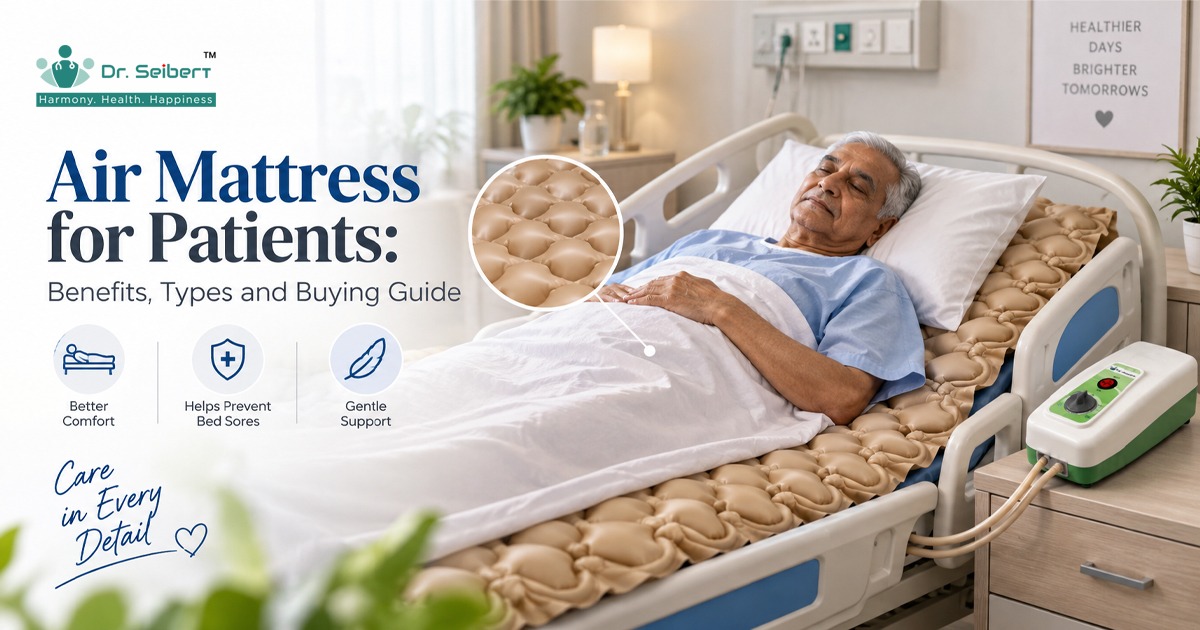
Air Mattress for Patients: Benefits, Types and Buying Guide
My grandmother had hip surgery a few years ago, and about two weeks into recovery, the physiotherapist noticed a red patch forming near her lower back. She hadn’t fallen, hadn’t hurt herself again — she’d just been lying on a regular foam mattress for too long without enough movement. The physio’s advice was blunt: get her onto an air mattress for patients before that patch turns into something worse. It did the trick, though I’ll admit we were skeptical at first. It just looked like a fancier version of the same bed.
Turns out it’s not about looks at all. If someone spends most of their day lying down — after surgery, during a long illness, or due to age-related immobility — pressure builds up in the same few spots for hours at a stretch. Hips, heels, tailbone, shoulder blades. A regular mattress can’t do anything about that. An air mattress can, because it keeps shifting where the weight actually sits.
Why Regular Mattresses Don’t Really Work for Long-Term Patients
Foam and spring mattresses were designed with the assumption that people toss and turn at night. Most healthy sleepers do, without even noticing. Patients often can’t, whether because of pain, weakness, or being physically unable to reposition themselves.
So the same points on the body keep bearing weight, hour after hour, and blood flow to the skin gets cut off in those spots. That’s the actual mechanism behind bedsores — not bad hygiene, not bad luck. Just sustained pressure with nowhere for it to go. And once a sore forms, it’s not a quick fix. Some take months. Some, honestly, never fully heal without proper medical care.
How an Air Mattress Changes That Equation
Most air mattresses for patients work using alternating air cells — rows of air pockets that inflate and deflate on a cycle, usually every few minutes. While one row is up, another is down, so no single area of the body stays under constant pressure for long.
It sounds almost too simple to matter, but this small mechanical trick is genuinely one of the more effective non-medical interventions for pressure sore prevention.
The Main Types, and Where Each One Fits
Alternating Pressure Mattresses
Pump-driven, cycling air between cell rows. Best suited for patients at moderate-to-high risk, including those already showing early skin breakdown.
Static Air Mattresses
No pump involved. Just air-filled cells sitting there, distributing weight more evenly than foam but without the constant movement. Cheaper option, though not ideal for someone who’s completely immobile for weeks on end.
Low Air Loss Mattresses
These slowly let air escape through a porous surface, which keeps the skin drier and a bit cooler. Useful for patients dealing with moisture issues, sweating, or existing wounds that need airflow.
Some families, especially for short recovery periods, look into something like a bubble wrap mattress as a cheaper stopgap. It’s fine for a few days of extra comfort. It’s not built to redistribute pressure the way an actual alternating system does, so I wouldn’t rely on it for anyone bedridden longer than a week or two.
Real Benefits, Not the Sales-Pitch Kind
- Meaningfully lowers pressure ulcer risk for patients confined to bed for extended periods
- Speeds up healing on existing sores by taking direct pressure off the wound
- Tends to improve sleep quality, both for the patient and whoever’s caring for them
- Some models let caregivers adjust firmness or cycle speed, which helps when a patient’s condition changes over time
Digital Pump vs Basic Pump: What’s Actually Different
| Feature | Digital Pump System | Manual/Basic Pump |
| Pressure adjustment | Automatic, can be programmed | Manual, needs regular checking |
| Best suited for | Long-term or high-risk patients | Short-term, lower-risk situations |
| Noise level | Generally quieter | Older motors can hum a lot |
| Maintenance | A bit more involved | Simple, fewer moving parts |
| Cost | Higher upfront | Easier on the budget |
Picking the Right One — Step by Step
- Talk to the doctor or physiotherapist about pressure sore risk level first. Everything else depends on that answer.
- Match the mattress’s weight capacity to the patient’s actual weight — not a rough guess.
- Check pump noise, especially if the caregiver sleeps in the same room. This gets overlooked constantly.
- Make sure the surface is waterproof or at least easy to wipe down, since incontinence is common in long-term care situations.
- Read the warranty closely. The pump, not the mattress fabric, is usually what fails first.
Where Families Usually Go Wrong
The most common mistake is grabbing the cheapest static mattress without checking how long the patient will actually need it. Fine for a two-week recovery. Not fine for someone who’ll be bedridden for months.
The other one — and I’ve seen this happen more than once — is completely ignoring pump noise, then discovering at 2 AM that it hums loud enough to wake the whole house. Test it beforehand if you can, or at least check reviews that specifically mention noise levels.
A Few Things People Usually Ask
Does every bedridden patient need an air mattress? Not necessarily. Someone recovering for a short stretch, with decent mobility otherwise, might manage fine on a regular mattress with frequent repositioning. It’s the long-term or high-risk cases where an air mattress makes a real difference.
Do patients still need to be repositioned if they’re on an air mattress? Yes. Most caregivers still reposition every 2 to 4 hours. The mattress lowers risk, it doesn’t remove the need for movement altogether.
Can it help heal a sore that’s already there? Often, yes — particularly low air loss or alternating pressure types, since they take pressure off the wound directly and improve airflow around it.
Will insurance or home care programs cover the cost? Depends a lot on the provider and region. Worth asking the hospital’s discharge planning team or checking directly with insurance before assuming either way.
The Final Word
Choosing the right air mattress for patients isn’t really about spending the most money on the fanciest model. It comes down to matching the mattress type to the person’s actual condition — how mobile they are, what their skin looks like now, and how long they’ll realistically be lying in that bed. Get that match right, and it’s not just about comfort. It’s one of the more effective ways to prevent a complication that’s genuinely difficult to undo once it starts.